Farmhouse Restoration in Tuscany From Abroad
Managing a Tuscan restoration from abroad requires clear roles, reliable updates, and documented approvals. Learn how to stay in control without being constantly on site.
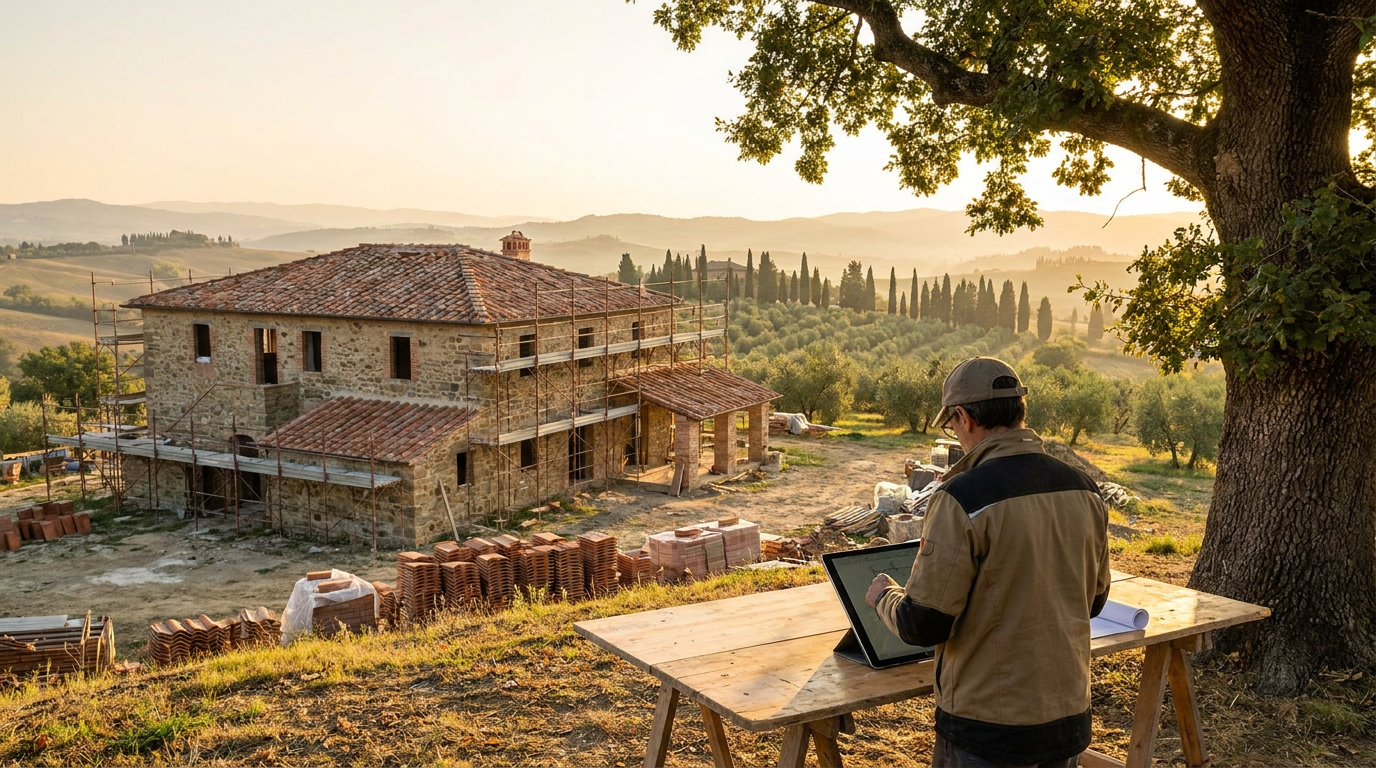
Managing the restoration of a farmhouse or villa in Tuscany while you live abroad can seem complicated. Distance, time zone differences, and unfamiliarity with Italian procedures can slow down decisions, especially when the project involves a historic building with architectural features that must be preserved.
However, farmhouse restoration in Tuscany can be managed accurately from abroad if you establish a clear system of responsibilities, communication, and oversight from the beginning. You do not need to attend every site meeting. What matters more is receiving reliable, comparable information that helps you make informed decisions. For many international property owners in Tuscany, the quality of project organization is therefore just as important as the quality of the work itself.
Why a remote restoration needs precise coordination
A complex restoration involves several professionals: the architect or designer, construction supervisor, contractor, craftspeople, systems specialists, and any specialist consultants. If each person contacts you separately, you may receive fragmented information that is difficult to interpret.
The first priority is therefore to establish clear operational coordination. A dedicated site manager gathers updates, coordinates the work, and alerts you only when a decision requires your approval. This does not replace the professional responsibilities of the architect or construction supervisor, but it creates a more orderly flow of information.
Distance becomes a problem when responsibilities, deadlines, and approval criteria are unclear.
To protect your interests, you need to know who checks technical execution, who coordinates the crews, who validates changes, and who can authorize financial commitments. These responsibilities must be defined before work begins, not during an emergency.
Prepare the project before construction begins
The most effective way to oversee a project from abroad is to reduce improvised decisions. A thorough preliminary phase helps identify the property's priorities, assess its condition, and schedule the work in the correct sequence.
Essential documents and inspections
Before starting the restoration, make sure the project team has collected and shared at least the following:
- current surveys of the building and outdoor areas;
- verification of planning and cadastral compliance, including whether municipal records and the Italian property registry match the existing building;
- an assessment of the walls, roof, floors, and foundations;
- guidance on historic features that must be preserved or restored;
- the architectural design and building systems plans;
- required permits and any conditions imposed by the relevant authorities;
- specifications covering materials, finishes, and construction methods;
- a preliminary work schedule and an updatable cost plan.
In historic buildings, some conditions may become visible only after plaster, flooring, or suspended ceilings have been removed. The financial plan should therefore include a contingency allowance, while the contract should explain how any changes will be documented and approved.
It is also helpful to create a digital sample library before work begins, with photographs, technical data sheets, and preselected alternatives. This allows you to approve flooring, colors, faucets, lighting, and custom woodwork without relying on occasional images sent from the job site.
Establish roles, authority, and response times
When renovating a farmhouse in Italy from abroad, a delayed decision can hold up several stages of work. You should therefore agree on a process defining which decisions are yours, which can be handled by the technical team, and which require formal approval.
A simple decision matrix
You can divide decisions into three categories:
- Preapproved decisions: Materials and solutions already approved in the project, which can be implemented without further confirmation.
- Operational decisions: Adjustments that do not change the appearance, performance, or cost plan and can be managed by the appointed professionals.
- Owner decisions: Design changes, functional modifications, additional expenses, or work affecting the schedule or the value of the project.
For the third category, each request should include a concise description, photographs, the technical reason for the change, its effect on the schedule, and its financial impact. If several solutions are available, you should ideally receive two or three comparable options accompanied by a reasoned recommendation.
You should also agree on response times. If you live in another time zone, you can establish a weekly meeting window and a separate communication channel for genuine emergencies. Written authorization allowing a trusted person to handle specific matters can be useful, but its limits must be clear.
Use digital reports that are genuinely useful
Photographs and videos are essential, but a disorganized collection of messages is not an effective monitoring system. Updates should follow an agreed schedule and consistent structure, allowing you to compare progress over time.
An effective report can include:
- work completed during the week;
- activities planned for the following period;
- dated photographs organized by room or area;
- comparison with the work schedule;
- materials delivered or still pending;
- issues identified and the proposed solution;
- decisions required from the owner;
- approved changes and their current status.
Video calls from the job site are particularly useful at key stages: opening walls, inspecting building systems before they are covered, reviewing installed samples, and checking finishes. Whenever possible, ask for images showing both details and a wider view of the room so you can understand their location and context.
All documents should be stored in a shared digital space with clearly organized folders and identifiable versions. Outdated drawings, unapproved estimates, and undated photographs can cause misunderstandings even on a well-managed project.
Monitor quality, changes, and final handover
Remote oversight is not only about confirming that work is moving forward. You must also be able to verify that the work follows the design, the construction supervisor's instructions, and the architectural character of the property.
Samples and work requiring approval
Before applying a finish throughout the property, it is prudent to produce full-scale samples. This is especially important for lime plaster, stone pointing, terracotta treatments, paint colors, flooring, and restored beams. Color, texture, and appearance in natural light can be very different from what you see on a screen.
The sample should be photographed under consistent conditions. When the decision is particularly important, it should also be inspected by the architect or your representative on site. If you can schedule visits to Tuscany, plan them around irreversible stages rather than general inspections.
Documented changes and traceable payments
Every change should be formally documented before the work is completed, except for urgent measures required for safety. The communication should specify the reason for the change, the estimated or confirmed cost according to the contract, the effect on the schedule, and the authorization received.
Payments should also be linked to verifiable project milestones and the documentation required under the contract. The construction supervisor and appointed professionals retain their respective technical responsibilities. Your operational contact helps provide you with a clear, unified overview.
Before handover, arrange a final room-by-room inspection and prepare a list of work that must be completed or corrected. You should also collect systems declarations, manuals, available warranties, updated drawings, and maintenance instructions. Complete documentation will remain valuable even if you do not live at the property full time.
In summary
A well-managed remote restoration begins with a thoroughly developed project, clearly defined roles, and regular updates. A dedicated point of contact, structured photographic reports, written change approvals, and inspections at key stages help protect the quality, schedule, and architectural integrity of your Tuscan villa renovation, even when you live abroad.
Tuscany Restorations has more than 30 years of experience restoring farmhouses, villas, and historic estates and is based in the province of Siena. Submit your property for a free consultation to assess your project's feasibility and discuss a management approach suited to an owner living abroad.