
Farmhouse Restoration in Tuscany from Abroad
Manage a farmhouse restoration in Tuscany while living abroad. Learn how a dedicated site contact, clear approvals and regular reports keep you in control.
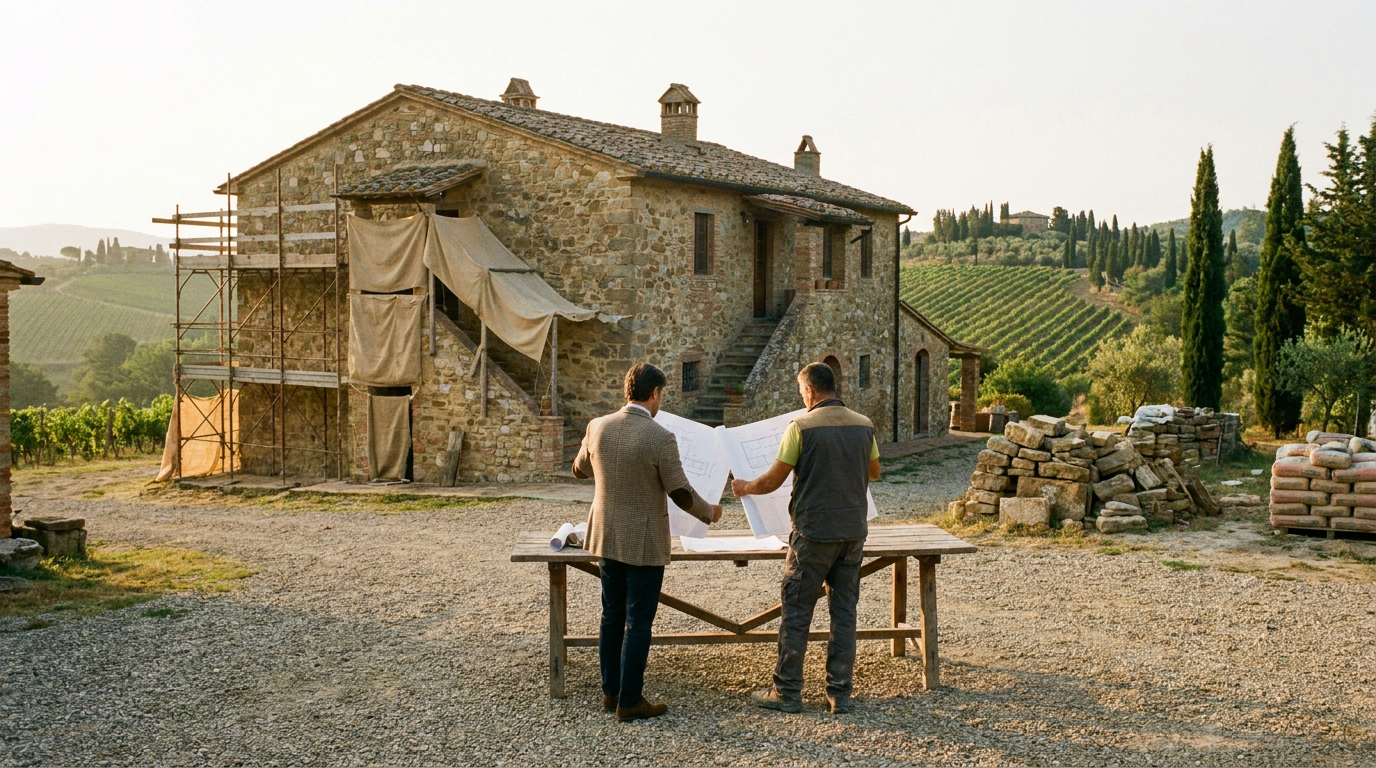
Managing a farmhouse restoration in Tuscany from abroad requires a more rigorous approach than overseeing the work in person. Distance, time zones and limited opportunities to visit the property make a dedicated site contact essential for coordinating professionals, tradespeople, suppliers and day-to-day decisions.
This does not mean giving up control. On the contrary, clearly defined responsibilities, shared documents and regular updates allow you to follow every phase with confidence. Here is a step-by-step approach to restoring a farmhouse or managing a Tuscan villa renovation while you live abroad.
1. Define your goals and priorities
Before work begins, you need to clarify how you intend to use the property. A home occupied for extended periods, a vacation home and a hospitality property require different choices regarding interior layouts, systems, maintenance and outdoor spaces.
Prepare an initial document, even a concise one, covering:
- the intended use of the property;
- the desired number of bedrooms and bathrooms;
- essential rooms and secondary spaces;
- the level of year-round comfort you expect;
- historic or architectural features to preserve;
- priorities for the garden, access and outbuildings;
- a target budget, including a reserve for unforeseen work and changes;
- your ideal completion date, clearly distinguished from any genuinely binding deadlines.
This phase prevents personal preferences and practical requirements from emerging only after work has already begun. If the property is in the Siena area, it may be useful to work with a company that has specific experience in [farmhouse restoration in the province of Siena](/en/tuscan-farmhouses), where local construction methods and the surrounding landscape require specialized knowledge.
Create a digital archive from the beginning
Floor plans, surveys, photographs, estimates, contracts, permits and technical data sheets should be stored in a shared location. Each file should include its date, version and responsible party, preventing decisions from being based on outdated documents.
2. Appoint a dedicated site contact
Your dedicated site contact connects you with what is happening at the property each day. This role does not automatically replace the technical professionals required under Italian regulations, such as the designer, the works director or the safety coordinator. Instead, the site contact performs a crucial organizational function by gathering information, checking progress and presenting the issues that require your decision.
Without this role, you may receive separate communications from builders, systems installers, carpenters and suppliers. You could then have to interpret incomplete technical information received at different times and without a complete overview.
An effective site contact should:
- understand the project and the property's priorities;
- coordinate the sequence of work;
- verify the availability of materials and tradespeople;
- document work that will no longer be visible after installation;
- promptly report problems and deviations;
- distinguish genuine emergencies from decisions that can wait;
- maintain a record of approved choices.
Distance becomes manageable when every piece of information has a responsible party, a deadline and a verifiable record.
3. Establish delegated authority and decision-making rules
Living abroad can make even a simple signature difficult. Before work starts, confirm with your professional team which documents require your physical presence, which can be signed digitally and which activities may require delegated authority or a power of attorney prepared by a qualified professional.
You should also define who can approve each type of decision. Your site contact should not make significant aesthetic or financial decisions without your consent, but must be able to manage routine activities within agreed limits.
A decision matrix can be very useful:
| Type of decision | Who prepares the proposal | Who approves | Required document | |---|---|---|---| | Technical detail consistent with the project | Technical professional or site contact | Works director, when within their responsibilities | Technical note | | Aesthetic change | Designer and site contact | Property owner | Sample or rendering | | Additional expense | Site contact and contractor | Property owner | Comparative estimate | | Safety emergency | Responsible professional | According to legal obligations and delegated authority | Report and photographs | | Change affecting permits | Designer | Property owner and relevant authorities | Updated drawings and documents |
The actual procedures must always comply with professional appointments, contracts and applicable regulations. The purpose of the matrix is to organize communication, not to overlap distinct professional roles.
4. Arrange regular, verifiable updates
Updates should arrive at an agreed frequency, not only when a problem arises. A weekly report is often a useful starting point, supplemented by immediate communication for urgent matters.
Each report should include:
- work completed during the week;
- current activities and the next scheduled steps;
- general photographs and significant details;
- any technical issues;
- decisions required, with a response deadline;
- the status of orders and deliveries;
- a comparison between planned and actual progress;
- a summary of approved changes.
Photographs should be clear and placed in context. A close-up of a wall may show a finish, but it does not indicate which room it is in. Wide-angle images, detailed photographs and references to the floor plan should therefore be provided together.
Schedule video calls from the property at key stages, such as before systems are enclosed, during the installation of principal materials or when finish samples are prepared. To better understand the overall sequence of work, read our guide to [farmhouse restoration timelines](/en/blog).
5. Monitor quality, costs and changes
In a historic property, some conditions only become apparent after removal and opening work begins. Concealed masonry, old systems, moisture, timber elements and previous layers of construction may require adjustments. For this reason, the initial budget must be supported by a transparent monitoring system.
Ask for every proposed change to specify at least:
- the reason for the change;
- the proposed solution and any alternatives;
- the estimated financial impact;
- the consequences for the work schedule;
- whether drawings or permits need to be updated;
- the date and method of approval.
Do not authorize significant changes through fragmented messages. Formal confirmation linked to a numbered document reduces the risk of misunderstandings.
Review materials using physical samples
Stone, terracotta, wood, lime and metals change in appearance depending on the light and workmanship. Photographs are useful for an initial selection, but they do not always represent color and texture accurately. When you cannot be present, request numbered samples, photographs taken in natural light and a comparison board.
For particularly important finishes, you can have samples shipped to your address or approve them during a scheduled visit. In the section dedicated to [our projects](/en), you can see how traditional materials and contemporary solutions can coexist when restoring prestigious properties.
6. Plan strategic visits and final handover
You do not need to be in Tuscany every week. It is more effective to concentrate your visits around the moments when your presence can lead to final decisions.
The most useful stages are generally:
- the initial site inspection and project definition;
- an inspection after the first removal work;
- approval of materials and samples;
- inspection of the rooms before finishes are applied;
- a pre-handover inspection.
Before booking a trip, request a precise agenda. Your site contact should prepare samples, updated floor plans and a list of open questions so that your time at the property is used productively.
Handover should be treated as a project phase in its own right. Arrange a final inspection, prepare a list of work still to be completed and schedule a follow-up check. Collect updated drawings, required declarations, manuals, available warranties, supplier contact details and maintenance instructions.
If the property will only be used during certain periods, also agree on post-construction management. This may include seasonal inspections, restarting systems, ventilation, care of outdoor areas and the prompt reporting of any problems.
In summary
Managing a farmhouse restoration in Tuscany from abroad is possible when the project is guided by clear responsibilities, organized documentation and verifiable updates. A dedicated site contact allows you to receive coordinated information, assess alternatives and approve every important step without being constantly present in Tuscany.
If you own a farmhouse, villa or historic estate and want to restore it while living abroad, submit your property to Tuscany Restorations for a free consultation. We will review its context and your requirements, then identify the most appropriate approach for supporting you throughout the project.