
Farmhouse Restoration in Tuscany: How to Spot Potential
A beautiful setting alone does not make a ruin a sound investment. Learn what to assess, from structure and access to planning compliance and restrictions, before you buy.
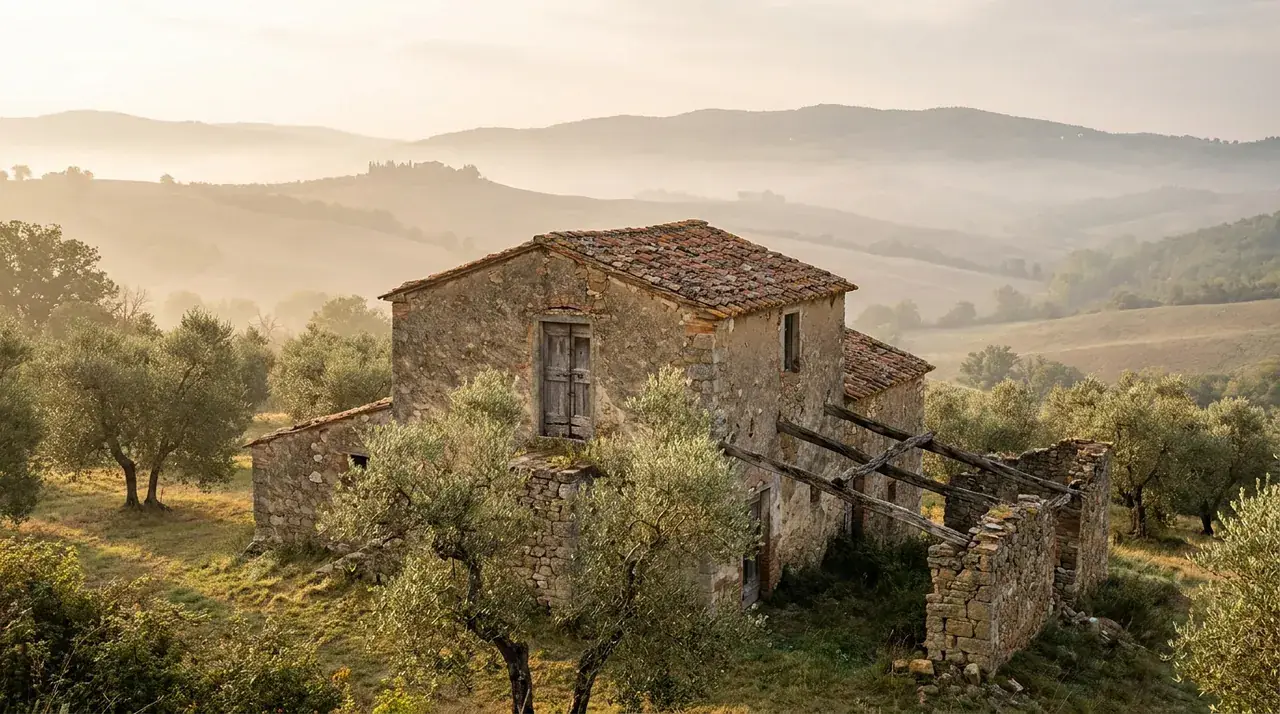
Buying a farmhouse in Tuscany often means considering buildings full of character but marked by time, neglect, or poorly conceived alterations. The beauty of the landscape and the appeal of ancient masonry may impress you immediately. To understand whether the property has genuine real estate potential, however, you need to look beyond that first impression.
A farmhouse suitable for restoration is not necessarily the best-preserved one. In some cases, a building that requires complete restoration offers greater design freedom than a property that has already been renovated badly. The difference becomes clear through a careful assessment of the architecture, structure, setting, and planning status. This is why a technical site inspection is essential before making an offer or developing a project.
1. Assess the location, access, and quality of the setting
Location affects both the farmhouse's current value and its ability to retain that value over time. A panoramic view is important, but you should consider it alongside more practical factors: accessibility, privacy, distance from services, and the quality of surrounding properties.
During your visit, check whether the access road is usable in every season and whether it can accommodate the vehicles required for future construction work. A narrow, steep, or unpaved road does not automatically make the purchase inadvisable, but it can make farmhouse restoration more logistically complex.
Also consider the relationship between the building and the landscape. A well-oriented farmhouse, protected from prevailing winds and open to attractive views, begins with favorable conditions. Look for power lines, noisy infrastructure, industrial or agricultural operations, and new developments that could affect your perception of the property.
Elements to examine include:
- sun exposure at different times of day;
- the quality and breadth of the views;
- distance from towns, airports, and major transportation links;
- the actual level of privacy, not merely the apparent level;
- the condition of private or jointly maintained roads;
- the availability of water, electricity, and data connections;
- access for construction and maintenance vehicles.
2. Learn how to read the existing structure
Irregularities in a historic building are not necessarily defects. Masonry that is not perfectly aligned, timber floors, and openings of different sizes may be essential parts of the farmhouse's identity. You must, however, distinguish signs of age from active structural problems.
Cracks, deformation, and the roof
Cracks require expert interpretation. Their position, shape, and width may indicate minor surface settlement or movement in the foundations and masonry. Sagging floors, walls that are no longer plumb, and deformed lintels also require closer investigation.
Inspect the roof from inside whenever it is safe to do so. Widespread water infiltration, deteriorated beams, displaced roof tiles, or abnormal pressure on the walls may require extensive work. This does not mean the farmhouse has no value. It means the restoration must be planned according to clear structural priorities.
Moisture and masonry condition
Moisture is common in rural buildings, especially when the exterior ground level is higher than the interior floors. Look for salt efflorescence, detached plaster, persistent odors, and staining at the base of the walls. These problems may have different causes and cannot always be solved with a single product or coating.
In restoration, what appears imperfect may be valuable. What is concealed without understanding its cause may become a problem.
A technical site inspection helps you determine which elements can be preserved. Stone walls, vaults, beams, terracotta floors, and original doorways can become defining features of the project, provided they are compatible with safety, durability, and contemporary living requirements.
3. Verify planning compliance and applicable restrictions
The property's potential also depends on what you can legally build or alter. Before purchasing, you should appoint qualified professionals to verify that the property's actual condition corresponds with its available building permits, plans, and cadastral records.
A farmhouse may have been altered over time through extensions, canopies, utility structures, or changes of use that were not properly documented. Their presence does not allow for automatic conclusions. Each situation must be assessed according to current regulations, municipal planning rules, and the property's approval history.
You must also establish whether the property is subject to landscape, architectural, hydrogeological, or environmental restrictions. Such restrictions are common in Tuscany and help protect the quality of the landscape, but they may affect materials, openings, exterior work, and approval times.
Useful documents to obtain include:
- current cadastral plans and property records;
- building permits and filed applications;
- records relating to building amnesties or legalization procedures, if applicable;
- title deeds and easements;
- details of the approved use of each part of the property;
- maps and requirements relating to applicable restrictions.
4. Determine whether the spaces can become a true home
A charming farmhouse must be able to accommodate a functional interior layout. Look beyond the existing rooms and consider whether the volumes allow you to create bright spaces, natural circulation, and a direct relationship with gardens, courtyards, and terraces.
The depth of the building, ceiling heights, and position of the windows all influence the quality of the finished result. Very thick walls and small openings are typical features, but they can leave some areas dark. The design must make the most of the available light without introducing solutions that conflict with the building's architectural identity or approval requirements.
Consider whether kitchens, bathrooms, utility rooms, and building systems can be installed without sacrificing the most interesting historic features. The position of the stairs is also critical. Moving them may improve the layout but could require substantial structural work.
For a high-end farmhouse restoration, consider from the outset the features that define contemporary living: thermal comfort, sound insulation, utility spaces, a laundry room, storage, a garage, and guest accommodations. If you envision a swimming pool, guesthouse, or outdoor kitchen, you will need to verify technical and planning feasibility rather than assume these additions will always be permitted.
5. Use a technical site inspection to identify risks and priorities
Your first visit helps you decide whether the property inspires you. A technical site inspection determines whether that vision can become a viable project. Whenever possible, arrange it before making binding commitments and involve architectural and structural professionals with experience appropriate to the property's complexity.
The inspection should assess the building as a whole, the land near the foundations, the roof, floors, walls, signs of water, and the general condition of the building systems. When specific concerns arise, measured surveys, exploratory tests, geological assessments, or additional specialist investigations may be necessary.
This stage does more than produce a list of defects. It allows you to identify:
- historic elements that should be preserved;
- urgent work required to make the building safe;
- improvements needed for comfort and efficiency;
- the main technical and approval-related uncertainties;
- a realistic sequence of work;
- an initial cost range, which must remain indicative until surveys and design work are completed.
For farmhouse restoration, a serious preliminary estimate must clearly distinguish between what can already be verified and what remains uncertain. Be cautious of overly precise estimates prepared without documents, measurements, or full access to the property. A good site manager can then coordinate the different specialists and provide regular updates, which is especially important if you do not live in Tuscany full time.
4. Inspect the land, orientation, and infrastructure
The value of a farmhouse does not depend on the building alone. Sun exposure, views, privacy, and land quality have a major influence on your experience of the property and its future potential.
A favorable orientation makes it easier to create bright interiors and may improve energy efficiency. You should also check for vegetation growing too close to the walls, slopes that channel water toward the house, and outdoor areas that are difficult to use.
Next, inspect the essential infrastructure: water availability and quality, the electrical connection, wastewater systems, cellular coverage, and internet access. In rural areas, you cannot assume that mains water or sewer service will be available. Wells, cisterns, and treatment systems must be assessed from both technical and regulatory perspectives.
Distance from services also deserves careful consideration. Seclusion can be an advantage, but it must remain compatible with your intended use, especially if you plan to make the farmhouse your permanent residence or operate it as hospitality accommodations.
In summary
A farmhouse with strong potential is not simply a beautiful building or an inexpensive purchase. It is a property where location, structural condition, planning compliance, spatial quality, and opportunities for transformation achieve a credible balance. Even significant problems can be addressed, provided they are identified early and incorporated into a coherent strategy.
Before deciding, visit the farmhouse more than once, gather all available documentation, and arrange a technical site inspection. This will help you distinguish authentic charm from hidden difficulties and plan a restoration that respects Tuscan architecture while supporting the way you want to live.
Submit your farmhouse, villa, or historic estate in Tuscany to Tuscany Restorations for a free consultation. We will review the property's characteristics with you and outline the first steps needed to turn its potential into a viable project.