
Farmhouse Restoration in Tuscany: Stone, Terracotta, Lime
Stone, handmade terracotta, and natural lime define Tuscan rural architecture. Learn how to preserve and integrate them in a respectful restoration.
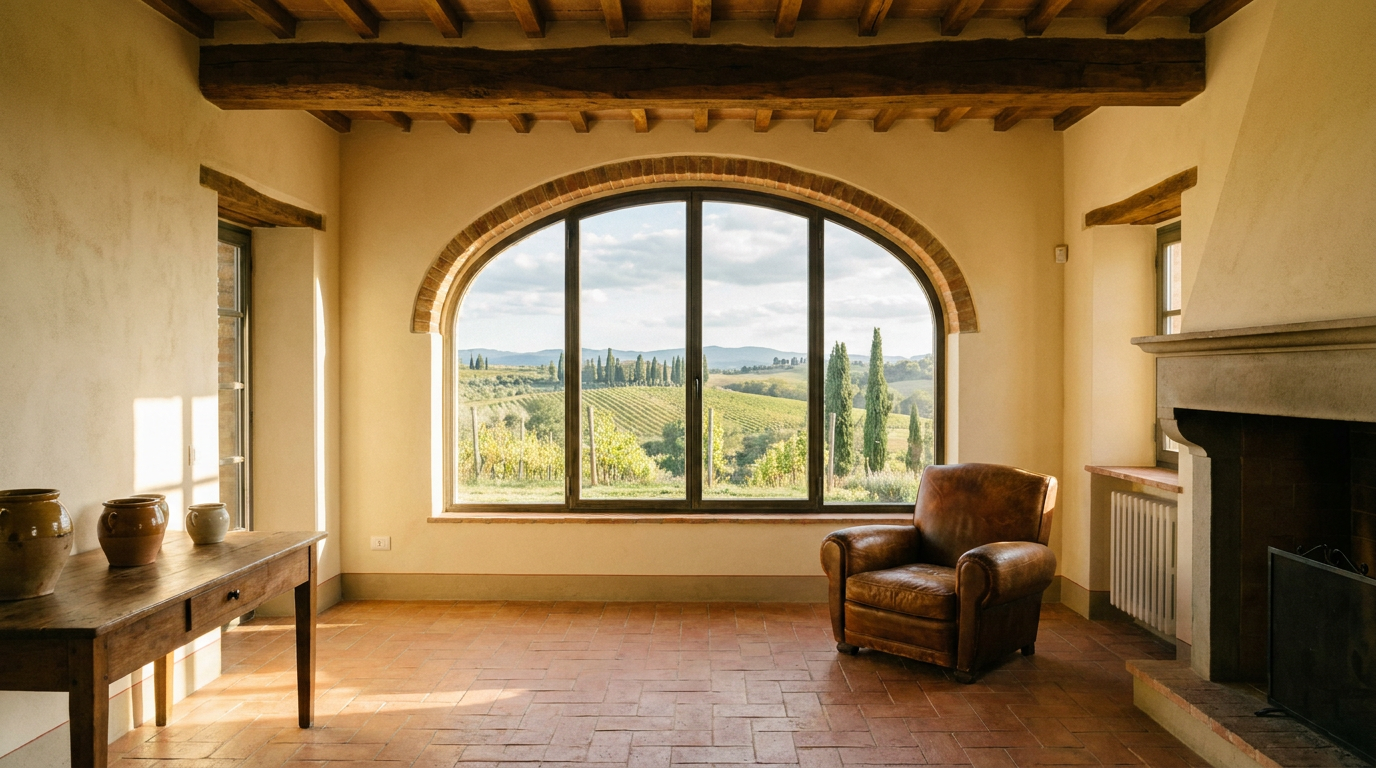
Restoring a farmhouse or historic villa in Tuscany means working with a balance built up over time. Stone walls, terracotta floors, and lime plaster are not simply decorative finishes. They reflect the local availability of raw materials, the skills of craftspeople, and the relationship between the building and its landscape.
When you approach a restoration, understanding traditional Tuscan materials helps you make consistent choices and avoid solutions that are incompatible with the original structure. The goal is not to artificially recreate an antique atmosphere, but to preserve what has value, integrate missing elements, and provide the property with comfort and durability.
Why traditional materials are still relevant
Stone, terracotta, and lime are found in many farmhouses, villas, and historic residences because they suit the region’s climate and construction methods. These materials can age gracefully, provided they are installed and maintained correctly.
Their restoration requires a technical approach. Before deciding whether to preserve, replace, or integrate an element, you need to assess its condition, the causes of deterioration, and its compatibility with the proposed work. An old floor, for example, may still be salvageable even if it has variations in color and irregularities. A wall that appears sound may conceal weakened joints or moisture problems.
The main benefits of using traditional Tuscan materials thoughtfully include:
- visual continuity with the original architecture;
- compatibility with historic masonry and porous substrates;
- preservation of traditional craftsmanship;
- better integration of the property into the landscape;
- the ability to repair individual areas without replacing entire surfaces.
The value of a restoration does not depend on how many new elements are added, but on the ability to create a dialogue between original materials, traditional techniques, and contemporary use.
Stone: structure, landscape, and identity
Stone defines much of Tuscany’s rural architecture, but it is not the same in every area. Its color, texture, and strength vary according to the local geology. For this reason, during farmhouse restoration in Tuscany, it is not enough to choose a generically rustic stone. You need to identify a material that is consistent with what is already present.
Preserve before replacing
The first step is a careful survey of the masonry. This examines the stability of individual elements, the condition of the joints, and the presence of cracks, erosion, surface deposits, or previous repairs made with materials that are too rigid.
Whenever possible, the existing stone should be retained. The work may include gentle cleaning, controlled removal of unsuitable pointing, localized consolidation, and repointing. The choice of mortar is essential. It must bond effectively without creating a barrier, and its properties must be compatible with the masonry.
When integrating new sections, it is important to avoid an excessively uniform effect. Historic masonry has variations in size, tone, and laying pattern that are part of its authenticity. Using reclaimed stone, or stone selected for its origin, dimensions, and appearance, can make the work more harmonious without creating a false imitation of age.
Exposed or plastered stone?
Not all stone walls were intended to remain visible. Many rural buildings were originally plastered, at least in part, to protect the walls from the weather. Leaving every surface exposed can therefore distort the building’s historic appearance and increase its exposure to water.
The decision should be based on surviving evidence, the architectural context, and the condition of the wall, rather than on visual preference alone.
Handmade terracotta: warmth and controlled imperfection
Terracotta is one of the most recognizable materials in Tuscan architecture. You will find it in interior floors, porticos, staircases, thresholds, and sometimes roofs. Handmade terracotta is distinguished by slight variations in color, surface, and size caused by traditional production and firing methods.
These differences are not defects. They create depth and make each installation unique. However, this does not mean that every irregular product is suitable for a prestigious property. The quality of the clay mixture, strength, absorption, intended use, and compatibility with the installation system must all be evaluated.
Restoring existing floors
Before removing an old floor, it is worth assessing its condition carefully. If the tiles are stable and sufficiently intact, they can be cleaned and treated in place. When work on the substrate is necessary, salvageable pieces can be numbered, carefully removed, and later reinstalled.
Careful selection is essential. Heavily worn pieces can be used in areas with less foot traffic, while new additions can be distributed evenly. In some cases, it is preferable for the added section to remain visibly distinct. In others, a controlled mix of old and new terracotta creates a more continuous result.
The finish must also be chosen according to how the space will be used. A treatment that is too glossy or creates a surface film can alter the appearance of the terracotta and make maintenance more difficult. Kitchens, bathrooms, entrances, and outdoor spaces require specific treatment systems, selected after considering moisture, foot traffic, and the risk of staining.
Natural lime and the balance of historic masonry
Natural lime has traditionally been used for mortars, plaster, finishes, and paint. Its value in restoration comes primarily from its compatibility with porous historic substrates and its ability to support vapor transfer when used as part of a properly designed construction system.
Moisture in historic masonry cannot be addressed simply by applying a waterproof product. Coatings that are too impermeable can trap water, cause finishes to detach, and shift the problem to other areas. Before specifying the plaster system, it is therefore necessary to identify the source of the moisture. Water infiltration, rising damp, plumbing leaks, and inadequate ventilation each require a different response.
Lime can be used for:
- bedding and pointing mortars for stonework;
- multilayer interior and exterior plaster;
- finishes with a fine or lightly textured surface;
- mineral washes and paints;
- localized repairs on compatible substrates.
The result depends on substrate preparation, the composition of the mixture, application thickness, drying times, and environmental conditions. The experience of the craftspeople is also crucial. A well-executed lime surface has a depth and natural variation that are difficult to achieve with uniform industrial coatings.
How to combine tradition with contemporary comfort
Renovating a high-quality farmhouse in Italy requires you to balance architectural identity, performance, and everyday use. Mechanical systems, insulation, heating, and interior layouts cannot be designed separately from the masonry and finishes.
A radiant heating system beneath a terracotta floor, for example, requires the correct design of layers and joints. Insulation work must take the wall’s moisture behavior into account. Routes for electrical and plumbing systems must be planned to limit demolition and avoid cutting through historic elements.
Before work begins, it is useful to follow an orderly process:
- document the building’s materials, techniques, and alterations;
- carry out tests and inspections in significant areas;
- distinguish salvageable elements from those that are too damaged;
- prepare samples of masonry, plaster, color, and laying patterns;
- coordinate finishes, structures, and mechanical systems within a unified project;
- oversee the work through a consistent site manager.
This method is particularly important if you do not live in Tuscany full time. A single point of contact, supported by photographic updates and regular reports, allows you to follow decisions, sample approvals, and construction progress from abroad.
Natural lime and healthy masonry
Natural lime plays a central role in Tuscan villa renovation and work on rural architecture. With different formulations, it can be used for mortars, base coats, plaster, finishes, and paint. The choice should not be generic. The product must be selected according to the substrate, exposure, and required performance.
Compared with highly rigid, impermeable finishes, a properly designed lime system supports vapor transfer and accommodates the movement of historic masonry more effectively. This does not mean that lime alone can solve every moisture problem. Water infiltration, rising damp, inefficient drainage, and damaged roofs must be identified and addressed at their source.
Plaster and paint finishes
Lime surfaces gain depth from natural light and the subtle variations created by hand application. To achieve an elegant result, particularly in luxury properties, it is best to avoid overly theatrical patinas. Authenticity comes from the correct layering, the quality of the application, and colors carefully calibrated to the setting.
Before applying a finish to entire facades or rooms, it is useful to prepare samples of an appropriate size. The perception of color changes with exposure, the time of day, substrate absorption, and surface texture.
In summary
Stone, handmade terracotta, and natural lime are not a stylistic formula to be applied indiscriminately. They are materials that must be understood, selected, and used in relation to the building’s history, its actual condition, and the needs of your project.
In over thirty years of restoring farmhouses, villas, and luxury properties in Tuscany, we have learned that quality depends above all on the decisions made before construction begins. Assessments, samples, material compatibility, and coordination reduce unexpected issues and protect the character of the property.
If you own a farmhouse, villa, or historic residence in Tuscany, submit your property for a free consultation. We will review its characteristics, potential, and restoration priorities with you, providing a single point of contact and regular updates even if you live abroad.