
Farmhouse Restoration in Tuscany: What to Check
A practical checklist for reviewing documents, structures, restrictions, and costs before buying. Learn which inspections can help you make a more informed decision.
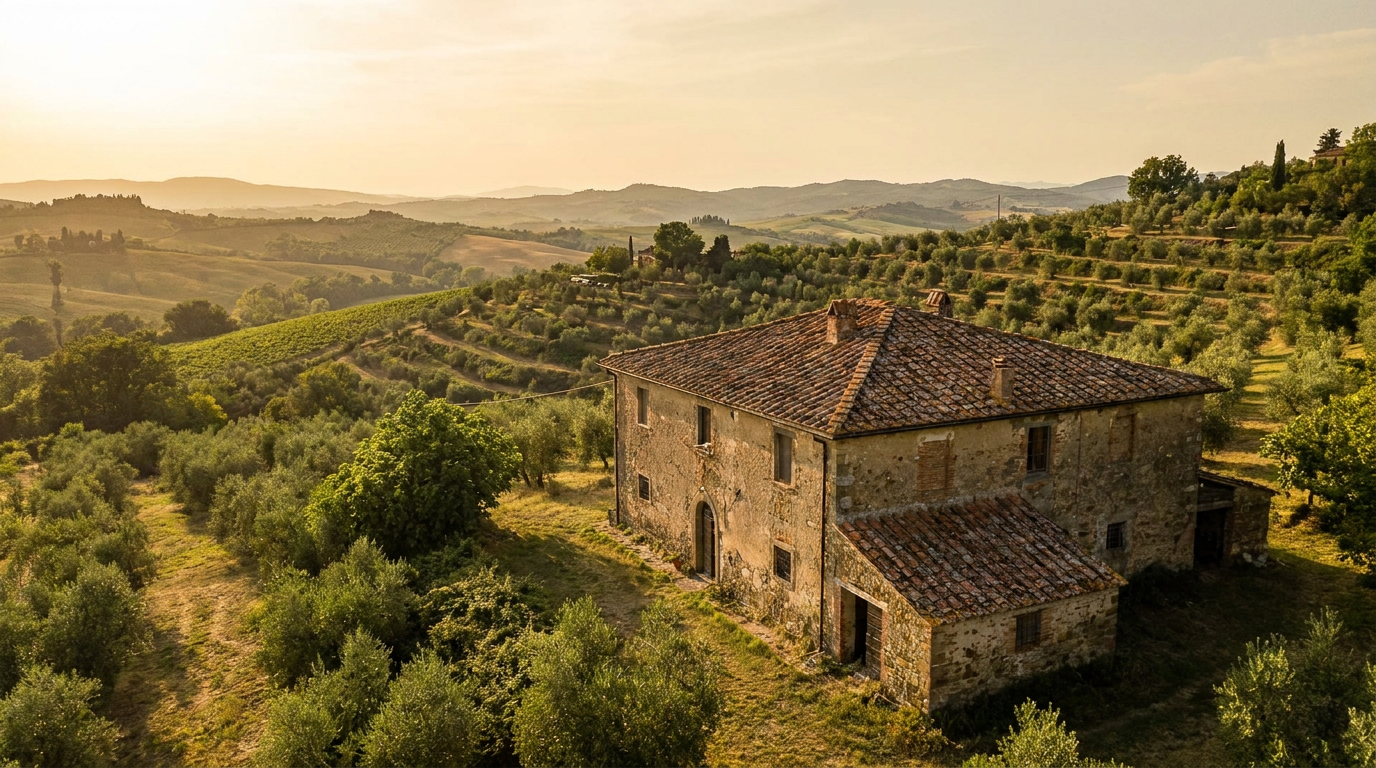
Your search for a farmhouse to restore in Tuscany may begin with a beautiful view, an antique stone doorway, or the desire to live in the countryside. Before making an offer, however, you need to know what to check so you can distinguish a property with genuine restoration potential from one affected by irregularities, restrictions, or work that is more complex than expected.
This practical guide takes you through the preliminary checks step by step. It does not replace due diligence performed by qualified professionals, but it will help you ask the right questions of the seller, real estate agent, and technical consultants. For historic or prestigious properties, the goal is not simply to estimate the work. You also need to establish whether the project you envision is compatible with the building, applicable regulations, and its setting.
1. Farmhouse restoration in Tuscany: documents to check
The first step is to verify the property's legal and technical identity. Photographs and real estate floor plans are not enough. You need to compare the farmhouse as it currently stands with the available documentation.
Ask for the following immediately:
- the deed establishing ownership and all relevant title documents;
- an up-to-date cadastral record;
- cadastral plans for every building;
- building permits and applications filed over time;
- details of any building amnesties, retrospective approvals, or applications still pending;
- a land-use planning certificate for the grounds, when required;
- documents concerning easements, rights of way, and access;
- an energy performance certificate, if required;
- any available compliance declarations for utilities and mechanical systems;
- information about landscape, cultural heritage, or hydrogeological restrictions.
Do not assume that a structure built many years ago is automatically compliant. An extension, veranda, agricultural outbuilding, or altered interior layout may not appear in the approved building records.
The Italian cadastral registry, known as the Catasto, describes a property primarily for tax purposes. On its own, it does not prove compliance with planning and building regulations.
Before making any financial commitment, appoint a local technical professional to reconstruct the legally authorized condition of the entire property, including outbuildings, ruins, existing swimming pools, and exterior landscaping.
2. What to check for planning and cadastral compliance
The second step is to compare three elements: the property as it currently stands, the records held by the municipality, and the cadastral plans. They should be consistent, or there must be a lawful procedure for correcting any discrepancies.
Inspect every room
During the site inspection, ask your technical consultant to check the position of walls, doors, windows, staircases, mezzanines, and utility or ancillary rooms. Outside, verify the building footprint, volume, roof, porches, terraces, and detached structures. A change in the use of a room can also be significant. An agricultural storage space cannot automatically be converted into a bedroom, kitchen, or guesthouse.
A discrepancy does not always make the purchase impossible, but you need to know:
- whether it can be regularized;
- which procedure is required;
- the likely timeframe and conditions;
- who will complete the necessary formalities before the final deed is signed;
- whether the discrepancy will restrict your future project.
If you plan to create additional bedrooms, build an extension or swimming pool, or restore an outbuilding, request a preliminary feasibility assessment. What is possible will depend on the municipality, the property's planning designation, the building's historic value, and any applicable restrictions. To understand the design approach as well, you may find it helpful to explore the difference between [conservation restoration and renovation](/en/blog).
3. Farmhouse restoration in Tuscany: structural checks
After reviewing the documents, turn your attention to the building itself. A visual inspection is useful, but it is not enough to assess the foundations, masonry, floors, and roof. Arrange an inspection with a technical professional experienced in historic rural buildings, preferably accompanied by someone familiar with traditional materials and construction methods.
Pay particular attention to:
- diagonal cracks or cracks running through masonry walls;
- walls that lean out of plumb or show visible deformation;
- sagging floors or roof sections;
- timber beams affected by rot, insect damage, or water infiltration;
- rising damp and areas where plaster is separating from the wall;
- leaks near gutters, chimneys, and terraces;
- ground settlement or retaining walls without adequate drainage;
- recent repairs that may conceal an underlying problem.
A crack does not necessarily indicate serious structural failure. Its shape, position, depth, development, and relationship to the structure all matter. Similarly, a roof that appears orderly may still require work if it lacks adequate structural connections or contains deteriorated timber elements.
Materials worth preserving
Create an inventory of the features that give the farmhouse its value: stone masonry, arches, vaults, beams, traditional terracotta ceiling tiles, cotto floors, fireplaces, door and window surrounds, and historic frames or shutters. These elements should not be treated merely as finishes. They can shape the design, require specialized craftsmanship, and determine the final character of the property.
Document them with photographs and ask which elements can be restored and reused. You can see practical examples in the section featuring [our work](/en).
4. Utilities, water, and comfort: a technical checklist
A farmhouse may be structurally sound but lack the infrastructure required for modern living. You therefore need to verify not only whether systems are present, but also their condition, capacity, and potential for upgrading.
| Area | What to verify | Possible issue | |---|---|---| | Electricity | Available capacity, electrical panel, grounding | Outdated wiring or insufficient supply | | Heating | Heat source, distribution system, fuel | Inefficient or undocumented system | | Water | Mains connection, well, storage tanks, pressure | Limited flow or well authorization requiring verification | | Wastewater | Sewer connection or independent system | Inadequate or poorly positioned system | | Connectivity | Mobile coverage, fiber, or alternatives | Weak signal in isolated areas | | Rainwater | Gutters, drainage, exterior grading | Damp and standing water near the foundations |
If the property uses a well, request the relevant documentation and assess the water flow and quality. For independent wastewater systems, check the permits, maintenance access, and distance from wells or waterways. You should also consider the technical space required for equipment, storage tanks, and utility distribution, especially if you want to minimize their impact on historic interiors.
5. Access, land, and restrictions beyond the farmhouse
The property's value and usability also depend on its surroundings. Travel along the access road yourself and verify whether it is public, private, or subject to an easement. A road that is suitable for a car may not accommodate construction vehicles, concrete mixers, aerial work platforms, or mobile cranes.
You should also check:
- boundaries and their correspondence with official maps;
- easements benefiting or burdening the property;
- shared road maintenance obligations;
- the stability of slopes and retaining walls;
- the presence of power lines, pipelines, or utility crossings;
- orientation, ventilation, and shade;
- flood risk, landslide risk, and soil characteristics;
- protected trees or vegetation requiring management;
- the actual distance from services and towns.
The Tuscan landscape is often subject to legal protections. These do not necessarily prevent restoration, but they may affect openings, materials, landscaping, fences, parking areas, and new construction volumes. If you are considering a property in the Siena area, you can learn more about our approach to [farmhouse restoration in the province of Siena](/en/tuscan-farmhouses).
6. Estimating the work before making an offer
Identifying problems is not enough. You need to turn the findings into a clear framework for your decision. Request a preliminary survey, an assessment of priorities, and an indicative estimate divided into categories. At this stage, all figures should be treated as approximate because the final cost will depend on the design, diagnostic investigations, permits, and conditions uncovered during construction.
An initial estimate should distinguish at least between:
- emergency stabilization and structural reinforcement;
- roof, floors, and masonry;
- damp remediation;
- utilities, mechanical systems, and energy performance;
- finishes and the restoration of historic materials;
- exterior work, access, and drainage;
- professional fees, surveys, and permit applications;
- a contingency allowance appropriate to the property's condition.
Then compare the estimate with your plans for the property. Ask whether the floor area, layout, access, and restrictions will genuinely allow you to create the home you want. If any checks remain unresolved, consult your notary and advisors about including suitable conditions in the purchase offer rather than relying solely on verbal assurances.
In summary
Before buying a farmhouse to restore, check the documents, compliance, structure, utilities, access, land, and restrictions. The most effective checklist is completed on site by professionals familiar with historic Tuscan buildings, with the property's architectural potential assessed alongside its practical feasibility.
Thorough due diligence cannot eliminate every unexpected issue, but it allows you to buy with greater awareness and establish a sound basis for the future restoration. Submit your property to Tuscany Restorations for a free consultation. We will review the farmhouse, identify the main technical priorities, and outline the next steps through a dedicated point of contact.