
How Much Does Farmhouse Restoration in Tuscany Cost?
Costs depend on the property's condition, restrictions, and finish quality. Explore indicative price ranges and the items to assess before restoring a Tuscan farmhouse.
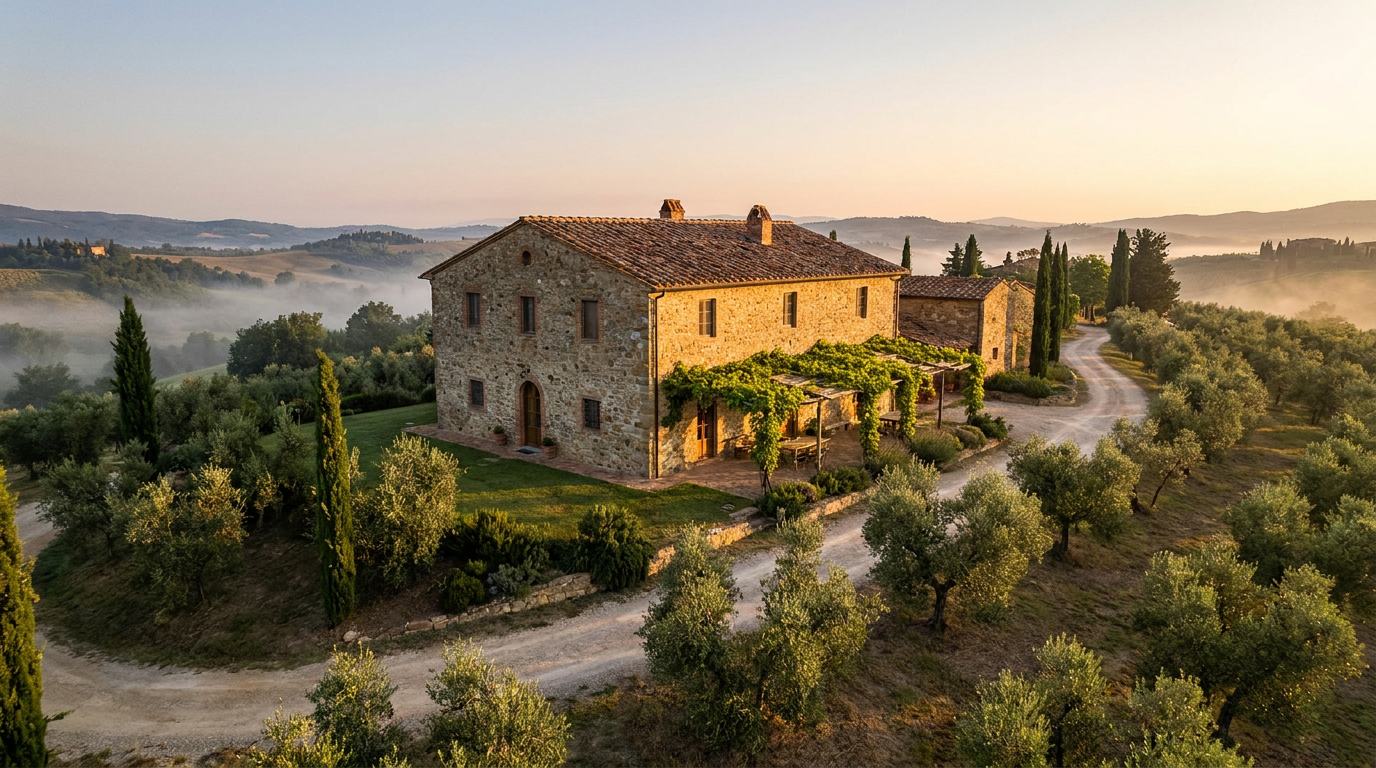
Restoring a high-end farmhouse in Tuscany means working on a building that embodies history, traditional construction techniques, and a unique relationship with the landscape. For this reason, estimating the investment is not simply a matter of multiplying the floor area by an average cost. You need to understand the structure, identify any restrictions, and define the level of quality you want to achieve.
The cost of farmhouse restoration can vary significantly, even between properties that appear similar. A building that has already been structurally reinforced and has recent systems requires a different investment from a ruin with a failing roof, damp masonry, and difficult access. The figures below are therefore purely indicative and cannot replace a technical site inspection and detailed bill of quantities.
What determines restoration costs
Floor area is important, but it is not the only factor to consider. In historic farmhouses, a significant portion of the investment depends on conditions that can only be fully understood through surveys, inspections, and targeted testing.
The factors that have the greatest impact on restoration prices in Tuscany include:
- the condition of the foundations, masonry, floors, and roof;
- cracks, settlement, rising damp, or water infiltration;
- any landscape, architectural, or archaeological restrictions;
- the quality and availability of traditional materials;
- the standard of finishes and degree of customization;
- the need to replace all building systems;
- site accessibility and distance from supply centers;
- work on courtyards, swimming pools, dry-stone walls, and private roads;
- the intended use, whether private or hospitality-related.
The interior layout can also affect the investment. Retaining the existing layout is often less invasive, while creating new openings in load-bearing walls, adding staircases, or forming large rooms requires structural assessments and specialized work.
In a high-end restoration, the right cost is not necessarily the lowest. It is the cost that protects the property's historic and real estate value over time.
The main cost categories
To understand an estimate, it is helpful to separate the different categories of work. Every farmhouse has specific priorities, but certain items recur on most Tuscan restoration sites.
Structural work and roofing
Reinforcing foundations, repairing masonry, strengthening floors, and rebuilding the roof can account for a substantial share of the investment. In a conservation-focused restoration, original beams, terracotta ceiling tiles, and roof tiles are salvaged whenever their condition allows, then integrated with compatible elements.
Structural assessments must come before aesthetic decisions. A roof that appears intact, for example, may conceal deteriorated beams, insufficient waterproofing, or inadequate structural connections.
Building systems and modern comfort
A high-end farmhouse should retain its identity without sacrificing comfort, safety, or efficiency. The investment may include electrical and plumbing systems, air conditioning, heating, water treatment, home automation, and security systems.
Installing these systems requires particular care. Chases, service shafts, and equipment must be coordinated to avoid damaging stone walls, historic ceilings, and original floors. Less invasive solutions may require more careful planning, but they produce a more harmonious final result.
Finishes and artisan work
Terracotta floors, lime plaster, local stone, custom windows and doors, wrought iron, and bespoke joinery affect costs differently from standardized materials. Costs increase when reclaimed elements must be selected, samples produced, or specialized artisans engaged.
In a high-end farmhouse restoration, quality depends on more than the price of the materials. Correct installation, compatibility between different types of work, and the ability to harmonize historic elements with contemporary additions are equally important.
Indicative price ranges per square meter
Without a design and site inspection, it is impossible to provide a reliable price. As an initial guide, however, you can consider the following indicative ranges for renovating a farmhouse in Tuscany:
- limited conservation work: approximately 1,200-1,800 euros per m², for properties in fair condition, with localized structural work and good-quality finishes;
- complete high-end renovation: approximately 1,800-3,000 euros per m², including replacement of building systems, structural reinforcement, a new layout, and selected finishes;
- high-complexity restoration: from approximately 3,000 to more than 4,500 euros per m², where there are serious structural issues, extensive artisan work, restrictions, or advanced technology.
These ranges are purely indicative and may vary according to market conditions, location, the property's actual condition, and design choices. You must also clarify what is included. VAT, professional fees, administrative applications, furnishings, exterior work, the swimming pool, and infrastructure work may not be included in the construction cost per square meter.
For larger properties, the unit cost does not automatically decrease. Some work benefits from economies of scale, while other work, such as restoring facades, roofs, or decorative elements, depends more on the building's complexity than on its interior floor area.
Costs you may underestimate
When assessing the cost of farmhouse restoration, it is common to focus on visible work and overlook activities that are essential to the project's success.
Items to verify from the outset include:
- architectural, structural, and building systems surveys;
- geological investigations and soil assessments;
- design, construction management, and safety coordination;
- permits and applications filed with the relevant authorities;
- new utility connections or upgrades to existing networks;
- drainage, water management, and damp prevention work;
- scaffolding, cranes, and logistics for sites with difficult access;
- disposal of materials and management of excavated soil;
- exterior lighting, gardens, roads, and parking areas;
- a contingency allowance for issues discovered during controlled demolition.
For a historic building, it is prudent to include a reserve in the overall financial plan. This does not mean accepting undefined costs. It means recognizing that some conditions only become visible after plaster, flooring, or suspended ceilings have been removed. The reserve should be managed through clear procedures, documentation, and prior approval of any changes.
How to keep costs under control
The most effective way to control restoration prices in Tuscany is to define the project carefully before construction begins. Late decisions, last-minute material selections, and uncoordinated work increase the risk of changes and delays.
Before starting, we recommend requesting:
- a complete survey of the property and its critical issues;
- a sufficiently detailed design that allows you to compare equivalent estimates;
- a bill of quantities listing quantities, materials, and work;
- a realistic construction schedule;
- clear rules for approving changes;
- regular updates on progress, costs, and required decisions.
If you do not live in Tuscany full time, having a dedicated site manager as your point of contact is particularly valuable. Receiving photographs, reports, and regular updates allows you to follow the work remotely while reducing misunderstandings among designers, the building company, artisans, and suppliers.
A company experienced in high-end farmhouse restoration can also help you establish priorities: safety and healthy living conditions first, efficiency second, and finishes last. This sequence protects your investment without compromising the property's architectural identity.
How to recognize a credible estimate
A professional estimate specifies quantities, materials, exclusions, and the construction schedule. If it consists of a page with three rounded figures, it is not an estimate. It is a hope. Always ask for excluded work to be clearly identified.
Professional fees, contingencies, and exterior work
The construction cost is not the same as the total investment. Depending on the project, you must add surveys, architectural and structural design, building applications, construction management, safety coordination, investigations, and testing.
As a purely indicative reference, professional fees may represent approximately 8-15% of the cost of the work, but the percentage varies according to complexity and the services required. It is also prudent to set aside a contingency fund of around 10-15% of the cost of the work. For historic buildings, this percentage may increase when it is impossible to determine the condition of every structure in advance.
Swimming pools, gardens, fences, wells, water treatment, access roads, and outbuildings must be estimated separately. On a large estate, exterior work can represent a significant expense even when the main building has no particular critical issues.
Any available tax incentives should be verified with qualified professionals based on current regulations, the type of work, and the owner's circumstances. It is not prudent to make the project's financial viability depend on incentives that have not yet been confirmed.
In summary
The cost of farmhouse restoration in Tuscany depends on the structural condition, restrictions, building systems, site logistics, and standard of finishes. Price ranges per square meter are useful as an initial guide, but only a site inspection and bill of quantities can turn a general estimate into a reliable financial plan.
With more than 30 years of experience restoring farmhouses, villas, and historic estates, Tuscany Restorations manages each project through a dedicated site manager and provides regular updates, including for owners who live abroad. Submit your property for a free consultation: we can assess its characteristics, potential, and initial restoration priorities.